Kimmel Trading - A Modern Collection
westerncarolina

westerncarolina

Kimmel Comp

Kimmel Comp

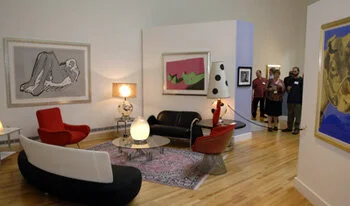
I had the privilege of touring Kimmel Trading's museum worthy collection of 20th century modern furnishings today in their showroom in downtown Asheville.  The curator, Mark Field, is an art and design major and was hired by Joe Kimmel to manage his collection among other things.   Here is how they describe their collection on their website, "The Kimmel Collection has a rock-solid foundation on which to build, the Kimmel Collection offers a point of orientation and discussion in tracking the evolution of Modernism, which, in itself, is difficult to define. The Kimmel Collection exhibit featured wide ranging American, European and Scandinavian fine art and design spanning 100 years from 1885 to 1985."For more information on Kimmel Trading and how to view or purchase from their collection please click here!

Asheville Design Center

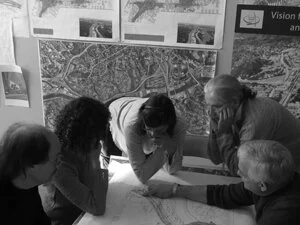
Building livable communities through planning and design. I wanted to take a moment to acknowledge the Asheville Design Center and the great work they do for the community.  More information on them to come in the future.  In the meantime this is how they describe themselves on their website:

website_charrettebw230

website_charrettebw230

"The Asheville Design Center engages a diverse community of approximately 75,000 Asheville citizens and nearly 1 million Western North Carolina citizens in quality design and planning solutions that promote livable communities. We are dedicated to educating the public about the importance of quality civic design and providing a means for people to work together in developing their communities.

The ADC is located in downtown Asheville where we have meeting, work and exhibit space. We offer a multidisciplinary team of volunteer professionals including architects, planners, landscape architects, urban designers, community advocates, and others to give shape to community visions."

September Design Forum

Architecture in the Public Interest:  The Roles of Academia, Prof.  Georgia Bizios. Established in 2004, the Home Environments Design Initiative (HEDI) at NC State’s College of Design initiates, facilitates and coordinates scholarship, research and outreach services in the area of quality design for home environments. HEDI provides a forum for the discussion of housing design issues among academics, professionals and the public. Join us at ADC and be a part of the discussion! Sept. 15 at 6:30pm, Asheville Design Center. Information courtesy of Asheville Design Center

Blast from the Past - Year 1960
C:UsersJWHITW~18-29-2010 03;22;38PM.PDF

C:UsersJWHITW~18-29-2010 03;22;38PM.PDF

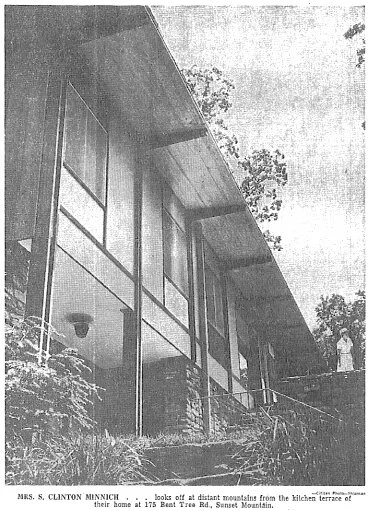
Article from The Asheville Citizen, Thursday July 28, 1960

Minnichs' Mix Contemporary With Tradional

What kind of house does and architectural engineer build for himself?  The home of S. Clinton Minnich on Sunset Mountain is a fascinating example.  Clint, an engineer, and Tony Lord, architect, two of the Six Associates, worked for a year in their spare time on the plans.  The Minnichs wanted a contemporary design as a background for traditional furniture and wanted to try new materials and new uses of old materials.Marian says that people are beginning to call its location “Rotary Ridge” because so many members of Rotary Club live up there.  From the mail box where one turns off Old Toll onto Bent Tree Road it is half a mile to the house.  A walk at the left of the carport leads to a front door set between floor-deep windows with louvered glass above.  The exterios is stone from Flag Pond, Tenn, and oak siding.  Oak and firpanels on the “town” side are painted Delft blue, yellow, rusty red, black and white above and below aluminum windows.  Marian actually had nightmares worrying about the effects before they were finished.Many things about the house are unusual.  The only conventional ceilings are in the kitchen and bathrooms, the rest are raftered with exposed beams bolted together with large iron bolts at the rooftree.Room dividers separate living and dining areas from the entrance hall and breakfast from the laundry area in the kitchen.  This gives a feeling of height and spaciousness.  It also provides better circulation of air.  The whole place is practically dust-free because of the warm air furnace equipped with an electro-static filter.  Thanks to Clint’s efforts it can be washed out in a few minutes by merely turning a valve.Another feature is the absence of plastered walls.  The whole fireplace end of the living room is stone, another wall is pine stained blue-green-gray and the rest is glass door and windows framing the western expanse of mountains.Pine panels the master bedroom, 13 year-old Ken’s room and the rumpus room and Larry’s immediately below.  All of the oak floors are done with a dull, walnut wax stain instead of shellac.  Washable pink plaid fabric wallpaper and resilient black-streaked vinyl tile floor decorate the bath adjoining the two first floor bedrooms.Great thought has gone into planning the large and workable kitchen.  The overall color scheme is grey and turquoise but cabinet doors are each painted a different color, picking up some of the soft deep tones of exterior panels.  Just think how convenient that would be to identify where something is – such as the salt behind the blue door.The gray slate entrance hall and stairway lead down, beside a red brick wall, to the lower level.  Sliding wood panel folding doors open on a rumpus room with raised brick fireplace and whole wall of bookshelves.  Furnished with studio beds it doubles as a guest room.  To the left is a bath having a stall shower of beautiful red Tennessee marble.  Across the hall is a tiny efficiency kitchen.  When Marian’s parents, Capt and Mrs. K.B. Bragg of Annapolis, MD. Are here they like to get up early and prepare their own breakfast.  Frequently when entertaining Marian bakes a ham or turkey down there.  Of course the refrigerator is stacked with snacks for the teenage boys and their friends.Larry, now 15, hopes to go into medicine, so bookshelves in his room are adjustable for large textbooks in the future.Opposite is what every house should have, a workroom with built-in desk on one wall and huge deep storage shelves for luggage and “junk” on another.  Marian has made heavy draw curtains to conceal them, but mostly they are pulled back.  Her sewing machine stands open in the middle.  A phone with a long cord is accessible to the other rooms by means of a pass through.Not quite visible at lower left of the picture is a door from the rumpus room to the small terrace, one of two and the front walk fromed of gravel heavily mixed with concrete to look like stone.  Above, out of sight, off the master bedroom is a redwood balcony supported by the house beams.Like everyone who has built recently the Minnichs found that costs exceed the budget, necessitating elimination of something.  In their case they amputated a third bedroom on the first floor and workshop for Clint below.  Now they don’t even feel the need of them.Note: Clinton Minnich was an engineer employed by the Six Associates.  The Six Associates were: William Waldo Dodge, Jr., Henry Irvin Gaines, Anthony Lord, William Stewart Rodgers, Erle G. Stillwell, Charles Waddell. Information couresy of Laura Hope-Gill.

FOR SALE - 308 Bouchard Ave., Valdese, NC
Main with Frame

Main with Frame

308 Comp

308 Comp

Main Back

Main Back

$269,900 3537 sq/ft 3 Bedrooms & 3 1/2 BathsBuilt 1955 Architect: Jim SherrillListed by: Troy Winterrowd

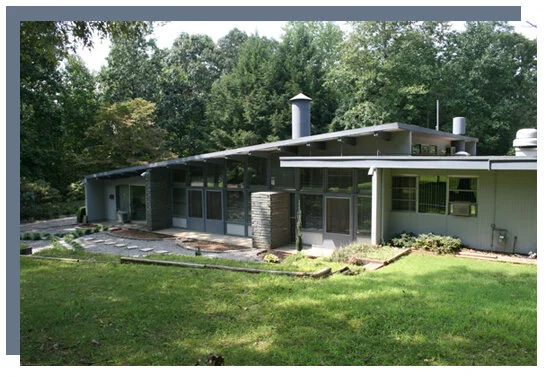
Come and take a look at this great mid-century modern home in the foothills area of North Carolina. All the great architectural lines, bones and details are still here.  Needs some cosmetic and system updating throughout, but has great spaces and flow. Open and spacious Mid-Century Modern home designed by Jim Sherill.  All public rooms flow into each other and the outdoors.  Separated by only 4 steps the bedroom wing offers three bedrooms with his and her baths and dressing room in the master.  Incredible built in storage throughout.  Slate terrace surrounds the private in-ground pool with retractable awning.To view this property's website please Click here!

"Your Town" Walkable Communities

I just came back from participating in a 3 day seminar in Michigan sponsored by the NEA and the Citizens' Institute on Rural Design called "Your Town".  This seminar of lectures and design charettes was held in the historic landmark "Old Schoolhouse" in the small coastal village of Douglas.  The focus of the seminar is on Walkable Communities.  Walkable Communities address the need to change our focus from a car or vehicle-centric nation, to a human-centric nation in the way we plan communities.  Associated with the current trend in Smart Land Development and addressing such qualities as diverse asaffordable housing, sedentary lifestyles, obesity and the corrosive effects of sprawl (all by-products of our vehicle-centric living) in our society, this well paced and participatory seminar helped a small West Michigan community identify ways in which it could plan to become a healthier and even more attractive place in the future.  The seminar host and co-founder, Dan Burden was on hand to help 50 local stakeholders (planners, the mayor, residents, teachers, and designers) organize into groups - armed with colored sharpies, aerial maps and tracing paper to plan ways in which problem areas in town could be addressed. Dan Burden and his staff's infectious optimism and consensus-building approach to dealing with traffic, access and safety was a refreshing approach.  Long-standing local infrastructure issues, complaints, and missed opportunities were identified through a design process that encouraged (by Dan and his team) looking beyond current and at times archaic ordinances and regulations and to identify potential.  The end goal of this and I am guessing many seminars will be the establishment of a Design Committee of citizens in order to further the discussion established in this Your Town seminar.  Link to Walkable and Livable Communities website: http://www.walklive.org/Article by Nicolaas Wilkens

Samsel Architects

Interview with Scott Huebner

exterior1

exterior1

Samsel comp

Samsel comp

sinift-fhb-ck21

sinift-fhb-ck21

The Architectural firm Samsel Architects was founded in 1985 by Jim Samsel in Asheville. From their informative and recently updated website one will find that the firm's mission: "stewardship for the environment, community and client's dreams" is what inspires their work.  On first impression, many of Samsel Architects' projects have a pleasing assured quality - a quiet, respectful connection to their surrounding site. In talking with Scott Huebner, a project architect at Samsel Architects' office, one discovers that these qualities often encompass larger efforts in attaining the right balance "between a strong connection to their Appalachian roots and a modern interpretation for today's contemporary lifestyles.” One finds that the efforts behind many of Samsel Architect's designs, both commercial and residential, are frequently the result a subtle and integrated layering of history, an understanding of place, and a progressive approach to sustainability.Believing that technology is one key element in the design of efficiently operated and inhabited buildings, a current residential project on the boards at Samsel is slated to include a green roof and solar hot water panels."  As clients begin to embrace these technologies, architects must take up the challenge to fully integrate them into our designs and still maintain our highest aesthetic standards." says Huebner.  Samsel Architects believes the technology should not rule or drive the aesthetics of the projects, but they should be integrated, and allowing passive aspects such as solar heating and air cooling, natural daylighting, shading and proper building siting define the architectural or aesthetic qualities of their buildings.Whereas we have a rich legacy of traditional building in the area, one finds that not all of Samsel Architects' work simply relies on direct facsimile of this legacy.  Their projects' connection to an Appalachian past can be seen in more innovative ways such as a strong integration of the local legacy of craftsmanship and the use of rich and earthen colors, and recognizable forms. “We have a great deal of respect for the craft and traditional building heritage of the Appalachian region, we view our work as a modern extension of this as seen in our use of timbers, stone, and other natural materials” says Huebner.  These elements are among the many which evoke a good sense of the richness of history without actually replicating that history. Each project  walks a fine line between that of the local vernacular and a modernism that is warm and inviting.  This successful approach gives a sense of  forward momentum coupled with an appreciation of the past on which they build for the future.  We look forward to seeing Samsel Architects' next project come to fruition.Interview and article by Nicolaas Wilkens, photos courtesy of Samsel Architects

FOR SALE - 121 Stoney Fork Rd.
121 Stoney - Main

121 Stoney - Main

121 Stoney Fork comp

121 Stoney Fork comp

sf-house-with-stream

sf-house-with-stream

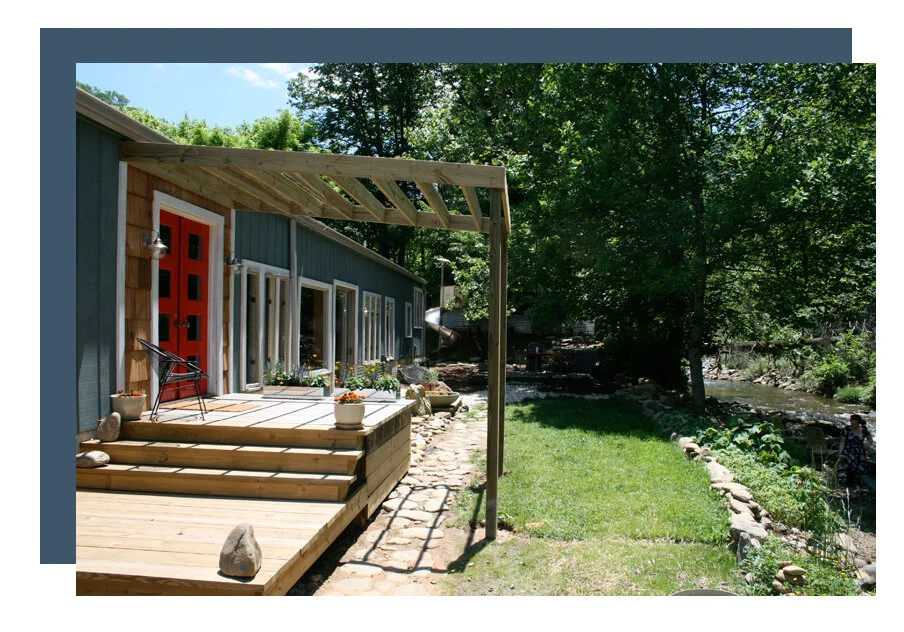
MLS#466034   $298,0004 bedrooms   2.5 bathrooms3860sqft (3200 finished)Listed by: Troy Winterrowd of Real LivingUrban meets the country in this perfect artist's or musician's live/work retreat.  Totaling 3860sqft this warehouse has been converted into loft style living on a bubbling trout stream.  Consists of a 2600sqft living space with 4 bedrooms/offices & 2 1/2 baths.  Also, it has a 600sqft garage/workshop space plus a heated studio of 660sqft.  The space is finished with rustic concrete floors, wood paneling, skylights, anderson casement windows.  The shop area is powered by 3 Phase electric for all your creative needs.  The kitchen contains sleek vintage sub-zero refrigerator and freezer.All of this on a 1 acre private lot with the relaxing sound of the bubbling stream.For more information on this property Click Here!

Graphic Elements

Bob Pazden captures Hoss Haley’s “Radius” show at Blue Spiral

Hoss Haley Radius Show -7

Hoss Haley Radius Show -7

Photographer Bob Pazden’s eye is drawn to graphic elements such as pattern, color, line, shape and form.  Which is the reason artist Hoss Haley calls Bob when he wants his work professionally documented.  Hoss’s creations have a quiet, graphic strength to them while Bob likes to quietly connect with what he is photographing.  Bob says, “Whether he is photographing architecture or people he is drawn to details and intimate experiences.”Hoss Haley currently has a one man show at the Blue Spiral gallery on Biltmore Ave. in Asheville.  In his artwork he uses concrete, steel and bronze to create two and three-dimensional artworks.  Favoring industrial materials and fabrication methods reminiscent of his past working on machinery in the west, his paintings and sculptures explore the use of forms, lines, surfaces and textures.

Radius Comp

Radius Comp

Hoss Haley Radius Show -4

Hoss Haley Radius Show -4

Hoss Haley Radius Show -12

Hoss Haley Radius Show -12

Hoss Pergola Comp

Hoss Pergola Comp

Hoss says, “We strive to bring our vision of order and progress to the world; but as quickly as our monuments beginning to dot the landscape, they are reclaimed by the forces of nature that we can never control.  I find great beauty in this inevitable contrast.  That is why I like to use steel.  It rusts; it shows age; it deteriorates.”  Bob took notice of the rich rust color and how it radiates off of the white walls of the gallery space.One of my personal favorite pieces at the show was Hoss’s version of a big spiral-graph machine that etched through enamel coated steel to leave a pattern that is both geometric and organic.Hoss was one of the select artists whose work went public in Pack Square.  This rhythmic trellis that helps tie together the two government buildings reflects the mountains scene behind. Below are a few detail shots of the trellis at night.  While photographing Hoss Haley's artist constructions Bob captures graphic compositions and creates new pieces of art with his camera.Photographs by Bob Pazden (www.bobpazden.com), Article by Troy Winterrowd